The 89th Regiment of Foot

The 89th Foot was raised in Dublin in 1793, on the outbreak of war with revolutionary France. In 1798, it suppressed the Irish rebellion before moving to the Mediterranean. When the regiment arrived in Malta from Messina in December 1799 it still had sick in Ireland.
In 1866, the 89th Regiment incorporated the words Princess Victoria in its title.
On 1 July 1881, The 89th (The Princess Victoria's) Regiment merged with the 87th Regiment of Foot to become the Second Battalion of the Princess Victoria's (Royal Irish Fusiliers).
In 1920, the regimental name changed to the Royal Irish Fusiliers (Princess Victoria's).
On 1 July 1968, the Royal Irish Fusiliers (Princess Victoria's) Regiment linked with the Royal Ulster Rifles and the Royal Inniskilling Fusiliers to form The Royal Irish Rangers.
The 89th Regiment of Foot
1799 — 89th
3 Jan 1799 The 89th embarked at Cork for Minorca. On 22 December 1798, the French had captured Naples and on 25 January 1799, converted the Kingdom of the Two Sicilies into the Parthenopean Republic. To safeguard Sicily, Lieutenant General Charles Stuart, commanding the army in the Mediterranean, moved the 30th (Cambridgeshire) Regiment and the 89th Regiment of Foot from Minorca to Messina.
18 Mar The 89th landed at Messina. It formed part of the garrison under the command of Colonel Thomas Graham.
10 Dec 32 officers, 28 sergeants, 414 men and 42 women arrived from Messina on HMS Foudroyant under Brigadier–General Thomas Graham. The 89th reinforced the Maltese insurgents in their blockade of the French garrison. On disembarking, the troops marched into billets at Birkirkara and Naxxar. They later moved to Gudja and Luqa to protect the advanced posts around Tarxien and Ta' Borg battery outside Tarxien, which held the 10 inch mortar and 68–pounder from HMS Bomb Vessel Strombolo.
16 Dec 1799 A regimental hospital was opened in a house at Luqa to care for fever patients.
1800 89th

Jan 1800 It is difficult to work out who was in actual command as the returns of 25 December 1799 to 24 January 1800 show that only Quartermaster Lieutenant Charles P Roddy was fit and on duty. Colonel Alexander Ross was absent on leave, Lieutenant Colonel Lord Blayney was absent on leave, Major William Raymond had not yet joined since his appointment, Captain John Le Mesurier was in Messina, Ensign William Cowell was sick in Messina, Adjutant Lieutenant Patt Agnew was sick, the regimental Surgeon Henry Reid was on duty but Assistant Surgeon John A Campbell was sick, Pay Master John Grant was absent on leave.
1 Feb Strength: 32 commissioned and warrant officers, 75 NCOs, 355 rank and file fit for duty, 97 rank and file sick, 563 total officers and men, 712 establishment.
Feb 1800 Regimental Strength:
| Present (Offs & WOs) |
Absent (Offs & WOs) |
NCOs | Fit for Duty (R&F) |
Sick (R&F) |
Total (Offs and Men) |
Establishment |
|---|---|---|---|---|---|---|
| 32 | 2 | 75 | 355 | 97 | 559 | 712 |
| Returns of His Majesty's Forces Malta: 1st February 1800. 89th (Ross's) | ||||||
21 June The 89th consisted of 2 Field officers, 9 captains, 15 subalterns and 3 staff. The other ranks included 35 sergeants of whom 4 were in hospital, 22 drummers (1 in hospital), 37 corporals (2 sick) and 388 privates, 33 of them in hospital. In addition there were 3 civilian servants, 61 women and 36 children.
4 Sep The French garrison in Malta surrendered to General Henry Pigot. The Maltese Islands were taken under the protection of the British Crown.
26 Nov The 89th and the 30th were ordered to prepare for immediate service and ceased to form part of the Malta garrison.
17 Dec 1800 The 89th embarked for Egypt under General Sir Ralph Abercrombie.
An infantry regiment was normally composed of ten companies. From 1799 to 1801 the following companies of the 89th Foot served in Malta:
- Colonel Blayney's Coy
- Lieutenant Colonel William Stewart's Coy
- Major Charles B Egertons' Coy
- Captain William Hilliard's Coy
- Captain John Aylmer's Coy
- Captain Bernard Stawell's Coy
- Captain George Power's Coy
- Captain William N Long's Coy
- Captain William Benson's Coy
- Captain John T Perry's Coy
Six companies were called the Service Companies and served abroad under the command of their commanding officer. The other four companies were called the Reserve Companies. These stayed at their Depôt in England and were commanded by a senior major.
The role of the Reserve Companies was to feed recruits to the Service Companies and to serve in England as a sort of internal police. Officers and men moved between the Service Companies and the Reserve Companies.
| Coy | Lt Col | Maj | Capt | Lt | Ensign | Sgt | Cpl | Drm | Pte |
|---|---|---|---|---|---|---|---|---|---|
| Ross | 0 | o | 2 | 6 | 0 | 4 | 3 | 2 | 36 |
| Stewart | 1 | 0 | 0 | 1 | 0 | 2 | 3 | 2 | 31 |
| Egerton | 0 | 1 | 0 | 1 | 1 | 2 | 3 | 2 | 29 |
| Hilliard | 0 | 0 | 1 | 1 | 1 | 3 | 5 | 2 | 36 |
| Aylmer | 0 | 0 | 0 | 0 | 1 | 3 | 4 | 1 | 33 |
| Stawell | 0 | 0 | 1 | 1 | 0 | 4 | 4 | 4 | 47 |
| Powell | 0 | 0 | 0 | 1 | 1 | 4 | 3 | 1 | 38 |
| Long | 0 | 0 | 1 | 1 | 1 | 4 | 4 | 2 | 34 |
| Benson | 0 | 0 | 1 | 1 | 1 | 2 | 3 | 2 | 30 |
| Perry | 0 | 0 | 1 | 0 | 1 | 4 | 5 | 1 | 53 |
| Grand Total | 1 | 1 | 7 | 13 | 7 | 32 | 37 | 19 | 370 |
| Table I Strength of 1st/89th Regiment of Foot in Malta from 25 November 1799 to 24 December 1799 (TNA:WO 12/9092). | |||||||||
1801 89th
Sep 1801 The 89th returned to Malta from Egypt, and embarked for Gibraltar and Ireland.
1803
27 Aug 1803 The first payment of prize money from the proceeds of the property captured in Malta on 4 September 1800 commenced to be paid out to the officers and men of 48th Foot.
Colonel William Stewart, Lt Col Lord Blayney, Major Charles B Egerton each received the sum of £845 11s 6d. Captains received £90 7s 6d, and lieutenants and ensigns f £43 4s 6d. Entitled sergeants were paid a first payment of £18 10s 6d, corporals, drummers and privates all received £3 0s 6d.
The 89th Regiment
1855 — 89th
In May 1854, during the campaign in the Crimea a reserve depôt of four companies were installed in Malta. These were formed into provisional battalions and were kept up until the Army in the East was disbanded with the Treaty of Paris.
Burials in 1855:
- 3 July Pte Edward McKinna 89th Regiment.
The 2nd/89th The Royal Irish Fusiliers (Princess Victoria's)
1937 – 2nd/The Royal Irish Fusiliers (Princess Victoria's)
2 Nov 1937 The 2nd/Royal Irish Fusiliers, The Faugh-a-Ballagh Boys, from the war cry of the 87th at Barossa, Fag an Bealac (Clear the Way), was reconstituted rapidly at Bordon to enable it to deploy for overseas service.
1938 2nd/Royal Irish Fusiliers

(Mtarfa Military Cemetery)

4 Jan 1938 21 officers and 466 other ranks 2nd/Royal Irish Fusiliers embarked at Southampton. It disembarked at Malta on 10 January. Their families joined them towards the end of the month. The battalion moved into Mtarfa Barracks.
19 Apr Capt QM J. G. Connors Royal Irish Fusiliers (Princess Victoria's) died at Mtarfa on 19 April 1938, aged 51 years. He had served with the regiment for 36 years. He was the son of CSgt J Connors who served with the 1st Battalion in the South African War. The family had a long history of service with the regiment. Capt J G Connors also had a son serving in the regiment. His ancestor was Cpl Patrick Connors who in 1881 wrote:
My grandfather Patrick Connors joined the 87th Regiment on its first formation in 1793. He enlisted in Limerick. My grandfather's eldest son Patrick Connors, my father, joined the 87th in 1823 and was discharged in 1845. He had three sons born in the regiment all of whom joined the regiment. Your humble servant was born in 1826 and joined the regiment in 1839 and was discharged in 1865. Three of my children, one of which is CSgt J Connors were born in the regiment.1
30 June Strength: 657 rank and file.
28 Sep Following the Munich Crisis, peace time training was suspended, telephones were manned day and night and air raid shelter pits were dug in the vicinity of the married quarters.
10 Oct 1938 The 2nd/Royal Irish Fusiliers embarked on the Neuralia for security duties in Palestine. It arrived at Haifa on 15 October and remained there for five months on internal security duties.
Their medical officer Capt Alan Francis Heber Keatinge won the Military Cross for attending the wounded under fierce fighting near the village of Um-ad-Daraj on 28 November 1938.
Baptisms at the Barracca Garrison Church Valletta in 1938:
- 15 Sep John McCurdy born 15 June 1938, son of Ellen Amy and CSM William Edward McCurdy of Mtarfa Barracks.
1939 2nd/Royal Irish Fusiliers
30 Mar 1939 The Faughs were relieved by the 1st/Green Howards in Haifa. It returned to Malta from Palestine on board the Dunera and formed part of Northern Brigade under Brigadier Oxley W.H. The battalion was commanded by Lt Col A Low MC.
On the outbreak of war on 3 September 1939, the battalion prepared and manned the beach defences. Each beach post consisted of a defensive position manned by seven to eight men armed with a Bren gun and medium machine gun. The posts were not fully occupied until April 1940.
30 June Strength: 25 officers and 631 men.
1940 2nd/Royal Irish Fusiliers

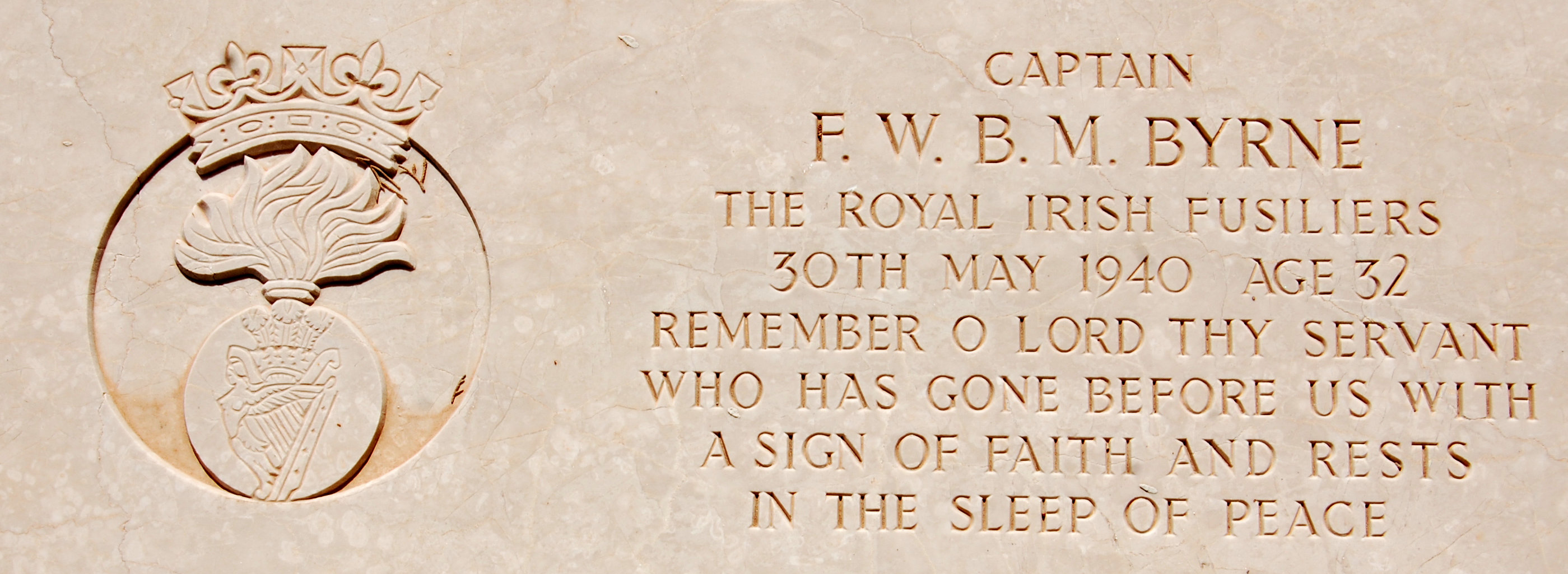
22 Jan 1940 Moved out of A, E, and G Blocks St Andrew's Barracks. It took over D Block and retained No 1 Room A Block, until a new hut became available in St Paul's Hutments, J Block, Australia Hall, the new cookhouse, dining hall, sports store and petrol store.
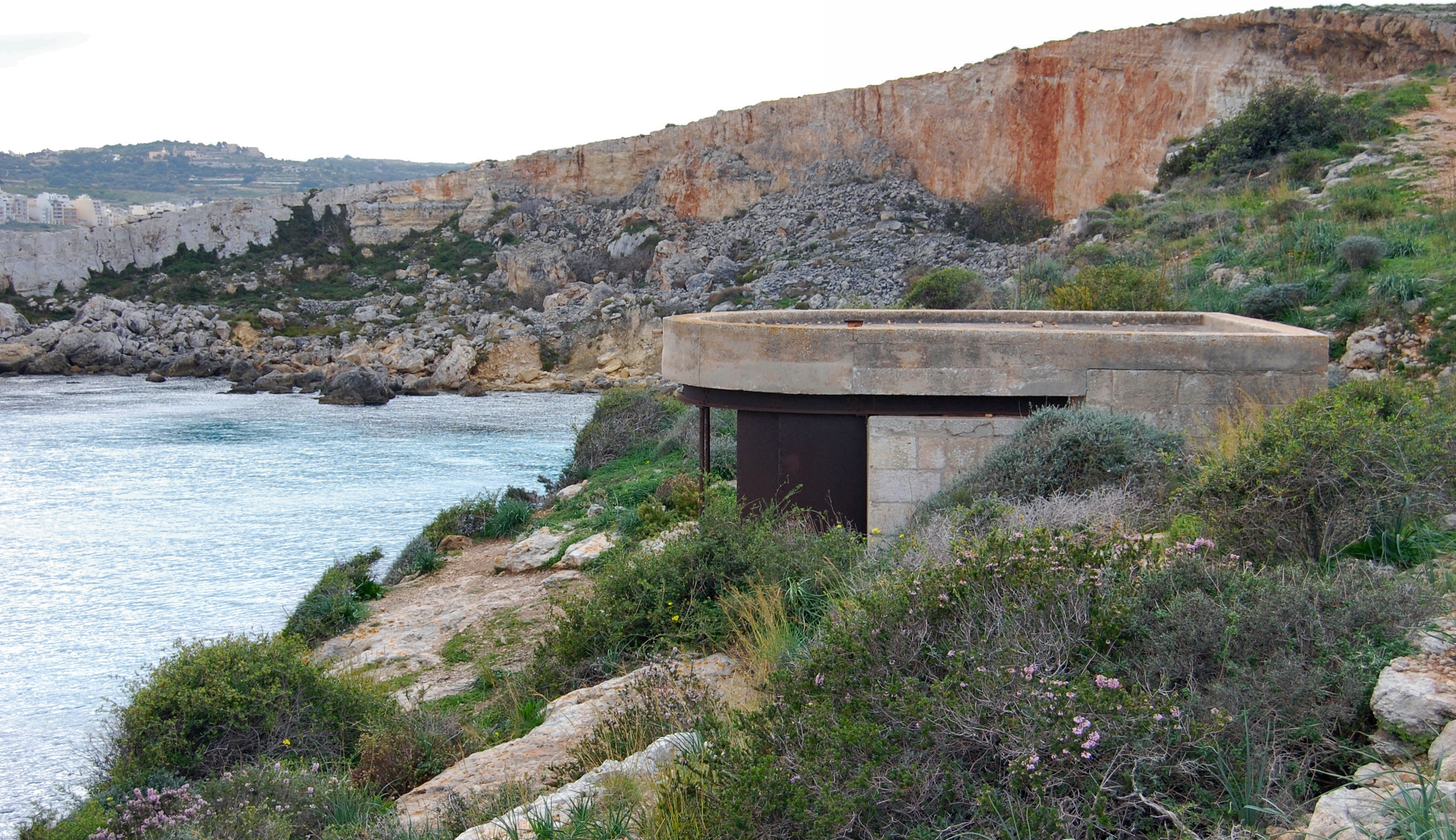
Apr 1940 The troops moved to their war stations. 2nd/Royal Irish Fusiliers' lines were at St Paul's Hutments. The Battalion moved out of its peace time barracks to man the coastal defences. Battalion HQ was at San Pawl Ta' Targa overlooking the Victoria Lines. A company was at Ta' Qali airfield below Mtarfa. The men filled in bomb craters on the runway and contributed to keeping the fighter aircraft operational.
20 May 8 Manchester arrived in Malta and the Wardija Sector was split so that the Manchesters occupied the western part and the Fusiliers the eastern part which was known as the Pembroke Sector.
In May 1940, 2nd/Royal Irish Fusiliers placed garrisons in: post R 5a Qala Hill (Gr 359313), R 6 (Gr 364315), R 7 (Gr 385318), R 8 Wardija Bty (Gr 3631), R 9 Wardija Church (Gr 3731), R 10 Jebel Ghauzara (Gr 3730), R 11 (Gr 37702295).
10 June One Coy 2/RIF maintained troops for local defence of the landing ground at Ta' Qali runway. It was supported by a carrier Plt of 2/RWK Regiment.
11 June Italy entered the war and commenced bombing raids on Malta. Malta's defences only consisted of 8 Light and 34 Heavy AA guns, 24 searchlights, one radar station and two airfields plus a few Gloster Gladiator type aircrafts. Apart from the Fleet and the Royal Marines the garrison included the coastal batteries of the RMA and three infantry battalions.
By the end of 1940, 400 Luftwaffe aircraft arrived at Sicily. Henceforth, attacks on the island by the Regio Aeronautica and the Luftwaffe intensified.
30 June Strength: 22 Officers and 691 men.
31 Oct Detachment of 2nd/Royal Irish Fusiliers occupied part of the St Pauls Hutments. The rest were prepared for use as a Convalescent Depôt.
15 Nov 1940 B Coy 2nd/Royal Irish Fusiliers moved into Villa Remigio Madliena.
1941 2nd/Royal Irish Fusiliers

11 Apr 1941 The 2nd Bn shot down a Junker 87 aircraft over Naxxar with small arms fire killing all three crew. Lt Col Low left the battalion to command a brigade and was replaced by Lt Col A A J Allen.
30 June 1941 Strength: 34 officers and 891 men.
5 Sep Strength: 48 officers and 929 men.
Oct Had a high incidence of scabies and pediculosis.
14 Dec 1941 4460365 Fus C. Rees was accidentally killed on the ranges.
1942 2nd/Royal Irish Fusiliers

6978473 Fus Albert Haunce died 15 Feb 1942 aged 20 yrs (Pembroke Military Cemetery).
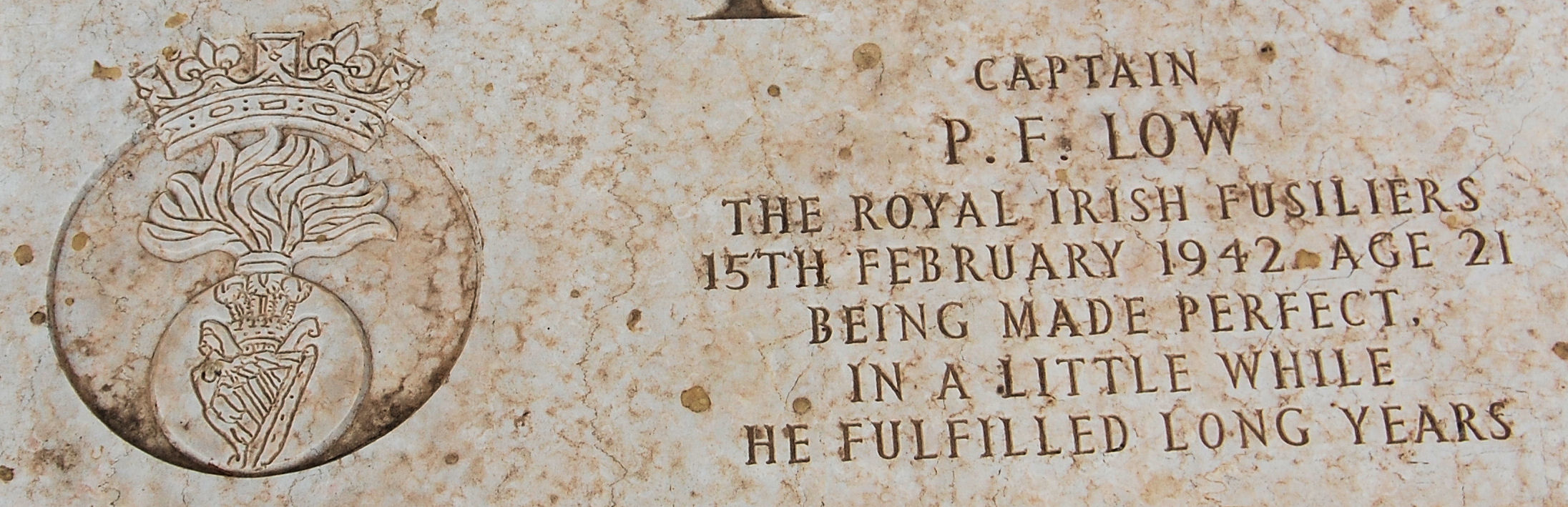
95532 Capt Peter Francis Low died 15 Feb 1942 aged 21 yrs (Pembroke Military Cemetery).

6978499 Cpl Douglas Baldwin died 21 Mar 1942 (Pembroke Military Cemetery).

4460944 Fus John Joseph Turnbull died 5 July 1942 aged 22 yrs (Pembroke Military Cemetery).
Three deaths on 15 February 1942, included those of Capt Hugh Gough OC D Coy and the Adjutant Capt Peter Low.
Jan 1942 The 2nd/Royal Irish Fusiliers took part in an experiment to determine whether scabies was transmitted through soldiers sitting on toilet seats. It was postulated that the latrine seat might be an important method of spread as most burrows of scabies in soldiers were confined to the buttock and genital region.
On 21 January 1942, an experiment was started in the 2nd/Royal Irish Fusiliers to determine whether wiping the latrine seat with a disinfectant would reduce the incidence of scabies. A picket was placed outside the latrines to ensure that the seats were properly cleaned. The experiment ran for two months.
25 Apr 1942 St Andrew's Barracks and 39 General Hospital were hit in a raid on Valletta. St Andrew's Barracks sheltered the families of the Royal Irish Fusiliers. Among the dead was Cpl Poynter, then in hospital.
1943 2nd/Royal Irish Fusiliers
June 1943 The 2nd/Royal Irish Fusiliers embarked for Alexandria. The village of Mosta presented the battalion with a model of a Gozo boat, Naxxar gave a silver model of a cannon, and Gharghur two silver cups to commemorate the friendship between the Fusiliers and their villages.
Most of July was spent at the Mountain Warfare Training Centre in Tripoli, Syria. In August it moved to Kebrit on the Suez Canal for practice with landing craft. It then moved to the Italian held island of Leros, one of the Dodecanese Islands in the Aegean Sea under the command of Lt Col Maurice French who was killed in action when German troops invaded the island.
Bibliography
- Farmer J. S., 1984. The regimental records of the British Army Reprint Edition, Trowbridge, Wiltshire: Crecy Books.
- Edwards T. J., 1980. Regimental Badges First Edition, Tonbridge, Kent: Ernest Benn Ltd.
- 1Cunliffe M., 1952. The Royal Irish Fusiliers 1793–1950, Oxford University Press.
- Harris H. Famous Regiments, The Royal Irish Fusiliers (The 87th and 89th Regiments of Foot), Leo Cooper Ltd., London.
- TNA:WO 17/2117, Monthly Returns to the Adjutant General (1800–1844).
- TNA:WO 177/1517, Medical Diaries No 57 Field Hygiene Mar 1941 to June 1944.
- TNA:WO 12/9092, General Muster Books and Pay lists 1st/89th Foot 1798–1799.
- TNA:WO 12/9093, General Muster Books and Pay lists 1st/89th Foot 1800–1801.
- TNA:WO 156/113. Register of burials September 1853 to June 1862.